.svg)
.svg)
.svg)
.svg)


.svg)


IR35: UK Off-Payroll Rules Explained
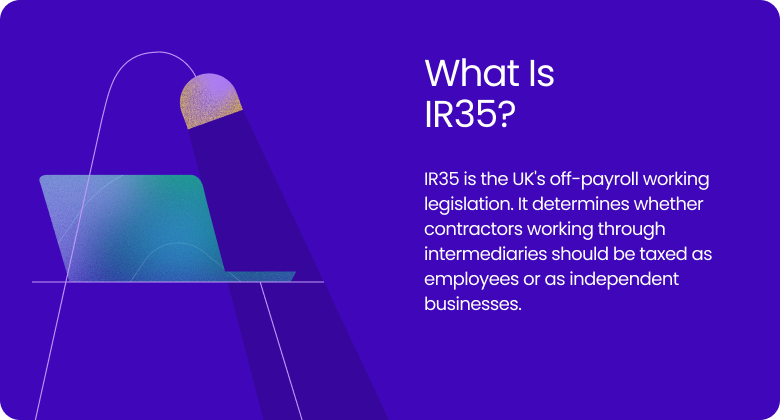
IR35 aims to ensure that workers who supply services through an intermediary pay broadly the same Income Tax and National Insurance as employees. That distinction matters because IR35 only applies where services are provided through an intermediary, usually a PSC or limited company the worker controls. It looks at whether the engagement is genuinely self-employed or employment in disguise.
If you’re a contractor, that means checking your contracts and working practices against IR35 and confirming whether your client has issued a status determination. If you hire contractors, you’re responsible for working out whether each engagement sits inside or outside IR35. Misjudge the status and you risk paying the unpaid tax and National Insurance yourself, plus interest and penalties.
Why Does IR35 Exist?
IR35 exists to stop disguised employment, where a worker appears self-employed on paper but works in a way that is closer to employment. It exists to make sure people who work like employees are taxed like employees, even if they bill through a company.
Consider two people doing the same job for the same manager. One is on the payroll and pays tax through PAYE. The other invoices through a limited company. Without IR35, the second person can often end up with a lower tax and National Insurance bill.
That gap is what the legislation targets, and it's a large one: HMRC estimates the reformed rules brought in around £4.2 billion in extra tax across their first four years, as reported by Accountancy Age.
Who Does IR35 Apply To?
IR35 applies to contractors who work through an intermediary, usually a personal service company (PSC), and to the businesses and agencies that hire them.
Responsibility under the rules depends on the client’s size and sector, so the exact obligations can shift between the contractor, client, and agency.
Genuine sole traders are generally outside IR35 because they contract directly with the client rather than through an intermediary. They still need to be classified correctly under normal employment status rules, because getting that wrong can create tax liabilities.
Does IR35 Apply to Sole Traders, Limited Companies, and Agencies?
IR35 does not apply to sole traders, but it can apply to contractors operating through a limited company. Agencies in the supply chain can also carry tax and compliance responsibilities.
- Sole traders: generally out of scope, because there's no intermediary.
- Limited companies and PSCs: in scope, because this is the structure IR35 was written to assess and where status determinations depend on the real contractor vs employee working relationship.
- Agencies and other labour suppliers: often act as the fee-payer — the party paying the worker's intermediary and running the deductions. HMRC calls this the deemed employer role, though the two aren't automatically the same party.
What Does Inside IR35 vs Outside IR35 Mean?
Inside IR35 means a contract is taxed like employment. Outside IR35 means the contractor is genuinely self-employed and manages their own tax as an independent business.
That status applies to each contract, so the same contractor can be inside IR35 on one assignment and outside it on another.
What Changes When a Contractor Is Inside IR35?
When a contractor is inside IR35, the fee-payer deducts Income Tax and employee National Insurance before paying the contractor's company.
Take-home pay is lower because income that might otherwise have been taken as dividends is taxed as employment income, and most self-employed expenses no longer apply.
For clients and agencies, the main change is that the engagement has to be run through PAYE, with employer National Insurance and the Apprenticeship Levy added on where applicable. That makes the payment process more like payroll than a standard supplier invoice.
What Changes When a Contractor Is Outside IR35?
When a contractor is outside IR35, they invoice through their own company, manage their own tax and National Insurance, and are treated as an independent business for that engagement.
You pay the invoice gross, their company accounts for its own tax, and your finance team treats them as a supplier rather than a payroll line.
Outside IR35 depends on how the engagement actually works, not just how it is described on paper. A contractor can be outside IR35 on one contract and inside IR35 on another, depending on the facts of each arrangement.
How Is IR35 Status Determined?
IR35 status is determined by looking at the real nature of the working relationship, including both the contract terms and the actual day-to-day working practices.
A contract helps, but it doesn’t decide the outcome on its own. HMRC looks at factors such as control, substitution, and mutuality of obligation, as well as the wider working pattern, including who provides the equipment, who carries the financial risk, and whether the work must be done personally.
HMRC also publishes a free tool called CEST (Check Employment Status for Tax). It helps you check whether a worker should be treated as employed or self-employed for tax purposes, based on the information you provide, and you can save the answers and result for your records.
Practical Tip
Before you sign, check who is responsible for deciding IR35 status, what the written decision says, and whether the way the work will actually be done matches the contract.
What Factors Matter Most: Control, Substitution, and Mutuality of Obligation?
The main IR35 status factors are control, substitution, and mutuality of obligation. Together, they help show whether a contract looks more like employment or genuine independent contracting.
1. Control: who decides how, when, and where the work gets done? A contractor with fixed hours, close supervision, and assigned tasks looks more like an employee.
2. Substitution: can someone else do the work instead? A genuine business can send a suitably qualified substitute.
3. Mutuality of obligation: is there an expectation that work will be offered and accepted on an ongoing basis? A continuing work arrangement is different from a defined project with a clear end point.
These factors are considered together, not scored separately, and HMRC also looks at other indicators such as financial risk and equipment provision.
Do Contracts or Real Working Practices Matter More?
Both matter, but HMRC places greater weight on how the work is actually carried out than on the contract itself.
A good contract is not enough on its own. If the contract includes a substitution clause but the hiring manager says only the named contractor can do the work, that clause carries little weight.
What matters is that the day-to-day working arrangements match the paperwork.
Who Decides IR35 Status?
It depends on the client’s sector and size. In the private sector, medium and large clients usually decide
Three cases, set out in HMRC's guidance for clients:
- Public sector client: you decide status and issue the determination, for every contract.
- Medium or large private-sector clients: you decide status, and if you don’t take reasonable care, you can become liable for the worker’s income tax and National Insurance.
- Small private-sector client: the contractor’s intermediary stays responsible, but you should still check that you meet the small-company test.
How the Small Business Exemption Works
If a private-sector client qualifies as a small business, responsibility for IR35 status generally stays with the contractor’s intermediary rather than the client. So, if you’re small, you do not usually make the status decision, issue an SDS, or handle the dispute process.
A business is small under the Companies Act 2006 if it meets two of three conditions: turnover of no more than £15 million, a balance sheet total of no more than £7.5 million, and no more than 50 employees, with the updated thresholds applying from 6 April 2026 (Forvis Mazars; ICAEW). The old limits were £10.2 million and £5.1 million.
Timing can be less straightforward, because small-company status is tested against filed accounts from earlier financial years.
That means when a business starts or stops being small depends on its year end and filing date, and some advisers expect the practical effect to begin from April 2027 for many companies (Greenberg Traurig). Confirm the current thresholds on gov.uk before relying on the small-company exemption.
What Is a Status Determination Statement (SDS)?
A Status Determination Statement is a written decision from the client saying whether the engagement is inside or outside IR35, and giving the reasons for that conclusion. You must send it to the worker and, where relevant, to the agency or other party in the supply chain.
The reasons matter because HMRC requires the SDS to explain how you reached the decision, not just state the outcome. In practice, that means the SDS should point to the factors behind your view, such as control, substitution, and mutuality of obligation, rather than just saying “inside” or “outside”.
If the worker or deemed employer disagrees, they can challenge the SDS, and you must respond in writing within 45 days. If you miss that deadline, the liability can shift to you.
What Changed Under the Off-Payroll Reforms?
The off-payroll reforms shifted responsibility for deciding IR35 status away from many contractors and onto client organisations and fee-payers, first in the public sector and later in the private sector.
From 6 April 2017, public authorities became responsible for determining status for the contractors they engaged. From 6 April 2021, that responsibility extended to medium and large private and voluntary sector clients (gov.uk).
The big shift in 2021 was not the rules themselves, which date back to 2000, but who decides and who carries the tax risk if the decision is wrong.
One more change is worth planning for: from 6 April 2026, PAYE responsibility for umbrella company workers moved up the chain to recruitment agencies, or to the end client where there's no agency (Hill Dickinson). If umbrellas were your route around IR35 risk, that route now carries its own liability.
What Taxes and Payroll Obligations Follow From IR35 Status?
IR35 status determines who must account for PAYE and National Insurance, and whether the contractor is paid through payroll or via a company invoice.
Inside IR35, the deemed employer deducts income tax and employee National Insurance, pays employer National Insurance and the Apprenticeship Levy on top, and reports it through PAYE Real Time Information.
Operationally, that's payroll, even though the contractor is not your employee. Outside IR35, the contractor’s company invoices you and accounts for its own tax, which is handled operationally as accounts payable.
Getting the operational side wrong is a common failure point for companies with no UK payroll of their own.
Need UK Payroll Handled Compliantly?
We handle PAYE and National Insurance for your UK employees, and manage compliant contractor payments separately. All with built-in compliance, so you stay accurate without setting up your own UK payroll or entity.
Speak to an Expert
Need UK Payroll Handled Compliantly?
We handle PAYE and National Insurance for your UK employees, and manage compliant contractor payments separately. All with built-in compliance, so you stay accurate without setting up your own UK payroll or entity.
What Happens if IR35 Is Applied Incorrectly?
If you misapply IR35, the consequences escalate quickly. You may face back taxes for income tax and National Insurance, interest on overdue amounts, penalties if HMRC finds errors careless or deliberate, disputes with contractors, and enquiries that drag on for years.
The public sector shows the scale of exposure. The Home Office’s three‑year enquiry (2018 – 2021) ended with a £29.5 million bill plus a £4 million suspended penalty, while the Department for Work and Pensions settled at £87.9 million (Abbiss Cadres). Both were well‑resourced and acting in good faith, yet still faced heavy liabilities.
Blanket determinations (treating every contractor as inside IR35 without looking at individual circumstances) may feel safe, but HMRC’s guidance (ESM10014) treats them as a failure to take reasonable care. Thin documentation is just as risky. If you cannot show how a decision was reached, you cannot prove you took reasonable care.
These mistakes often overlap with wider employee misclassification risks. Treating someone who works like an employee as a contractor can create tax, National Insurance, and rights exposure that goes beyond IR35 alone.
How Can You Reduce IR35 Risk When Hiring UK Contractors?
Businesses reduce IR35 risk by assessing status early, documenting their reasoning, aligning contracts with real working practices, and using a consistent process for every engagement.
- Assess the role before you engage anyone. It's far easier to shape a genuinely outside-IR35 engagement at the scoping stage than to argue for one later.
- Review the contract against reality. Check that substitution, control, and mutuality clauses describe what will actually happen. A clause you have no intention of honouring is worse than no clause.
- Brief the managers who'll work with the contractor. Don't assign tasks through your normal line-management channels, don't insist only this person can do the work, and don't fold them into rituals designed for employees.
- Document the decision through an SDS, with the reasoning, the evidence, the date, and your CEST output.
- Reassess when the engagement changes. Scope creep is usually the trigger. The role drifts from what the SDS described, and when that happens, status needs reassessing too.
A Simple IR35 Compliance Checklist for Employers
Here’s a practical checklist you can use to stay compliant when hiring contractors.
How Does IR35 Affect Contractors?
If you're a contractor, IR35 changes how your engagement is taxed, how much take-home pay you receive, and how carefully you should review contract terms before accepting work. Understanding the broader UK contractor landscape can also help you assess how IR35 fits into your overall working arrangement.
Take-home pay on an inside-IR35 engagement is meaningfully lower than the headline day rate suggests, so compare rates on a net basis. Flexibility narrows too, because the working practices that support outside-IR35 status are the same ones that give you genuine independence. Ask about status determination before you sign, not after the first invoice.
We help you classify, onboard, and pay UK contractors compliantly, with clear documentation and UK payroll for inside-IR35 engagements.
Speak to an Expert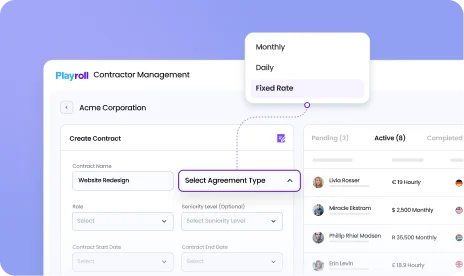
IR35 FAQs

.png)
No. Being inside IR35 means an engagement is taxed like employment, with PAYE and National Insurance deducted, but it doesn't make the worker an employee.
HMRC confirms these workers "are also not entitled to employment rights from you, such as holiday pay," and they don't receive statutory payments or pension auto-enrolment through the deemed employment. Employment rights are decided under employment law, on a separate test.
Yes. If a contractor or the deemed employer disagrees with a Status Determination Statement, they can put their objection to the client. The client must consider it, decide whether to change or confirm the determination, and respond in writing within 45 days. Miss that deadline and responsibility for the worker's income tax and National Insurance passes to the client.
Yes. IR35 is UK tax legislation and applies to UK engagements. Other countries have their own worker classification rules, which can be stricter in different ways, so an assessment built for the UK won't transfer. If you're hiring in several markets, you need a classification approach per country.

ABOUT THE AUTHOR
Justine Smith
Justine is a content specialist at Playroll, specializing in global HR trends and compliance. With a strong background in languages and writing, she turns complex employment issues into clear insights to help employers stay ahead of the curve in an ever-changing global workforce.

Back to Top
.svg)


Copied to Clipboard




















.svg)