.svg)
.svg)
.svg)
.svg)

In die Zwischenablage kopiert

Bereit zum Start?

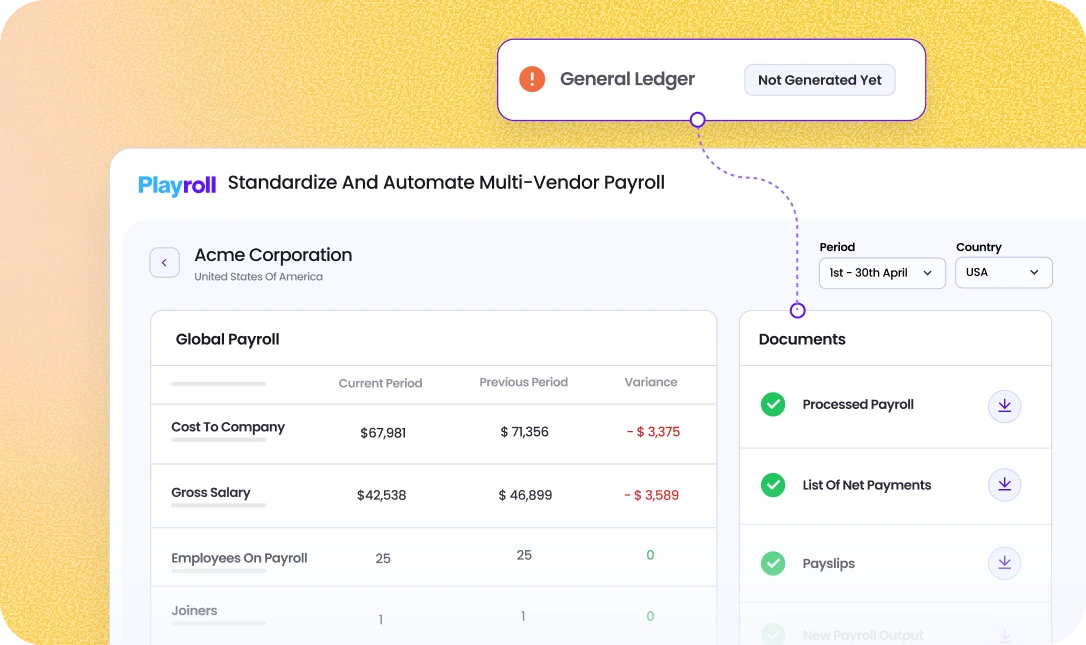
A global payroll platform is cloud-based software that centralizes and automates payroll processing for employees and contractors across multiple countries, ensuring compliance with local tax, labor, and reporting laws while providing a single, unified workflow.
That definition does a lot of work. The reason the category exists is that managing payroll country-by-country – with separate vendors, disconnected systems, and manual reconciliation – breaks down fast once you're operating across more than a handful of markets. A global payroll platform replaces that fragmented approach with a standardized, centralized system: one place where payroll data, compliance rules, and payment execution live for every jurisdiction you operate in.
In the context of international workforce management, a global payroll platform sits at the operational core. Global payroll management is the set of processes and policies used to manage payroll across countries – covering everything from hiring and onboarding to compliant, on-time pay in local currency. The platform is what makes that operationally possible at scale.
What a Global Payroll Platform Actually Does
A global payroll platform isn't just a payroll tool with a wider geographic reach. It's a distinct category with specific capabilities that domestic payroll software doesn't cover. Here's what you should expect from a platform built for international workforce management:
- Multi-country gross-to-net payroll calculations: The platform computes wages, deductions, and net pay according to each country's rules, handling currency conversions and regional specifics automatically. You're not running separate calculations for each market; the system applies the right logic per jurisdiction.
- Statutory tax and social security compliance per jurisdiction: Country-specific tax withholding, social contributions, and statutory filings are handled automatically, with rules updated as local legislation changes. Compliance requires correct tax withholding, worker classification, and local-currency payment – and the platform enforces all of this at the point of processing.
- Contractor and Employer of Record (EOR) payroll support: Leading platforms handle not just direct employees but also independent contractors and workers employed through an EOR arrangement. An Employer of Record is a third-party organization that legally employs workers on behalf of a client company in a specific country, handling payroll, tax, and compliance obligations so the client can hire internationally without establishing a local entity.
- Multi-currency foreign exchange and payouts: The platform manages currency conversion and local bank payments, so employees are paid accurately in their local currency without your finance team coordinating separate banking workflows per country.
- Integrations with HRIS and finance systems: Payroll data flows between the platform and your HR records, ERP, and accounting software without manual re-entry. This removes a significant source of reconciliation work every pay cycle.
- Consolidated reporting and analytics: A single dashboard gives you visibility into global labor costs, compliance status, and workforce data across every market. Payroll analytics can surface labor costs, turnover patterns, and compliance metrics that are invisible when data is scattered across vendors.
- Self-service portals give employees direct access to payslips, tax documents, and personal data at any time – reducing HR admin for routine requests.
- Automated error detection flags discrepancies before payroll is finalized, rather than after payments have gone out.
Global Payroll Platform vs. EOR vs. PEO vs. Local Provider
These four models are frequently confused, and choosing the wrong one for your situation creates both operational and compliance problems. Here's a clear comparison:
A Professional Employer Organization (PEO) is a firm that enters into a co-employment arrangement with a client company, sharing certain employer responsibilities such as payroll, benefits administration, and HR compliance, typically within a single country where the client already has a legal entity.
In practice, many companies end up with a hybrid approach – a global payroll platform for countries where they have legal entities, combined with an EOR for markets where they don't. Playroll operates through its own legal entities in most markets, which means it can provide both EOR and direct global payroll capabilities across 180+ countries from a single platform – without forcing you to choose between the two models.
Signs You Need a Global Payroll Platform
You don't have to hit a specific headcount to justify a centralized global payroll solution. The better question is whether your current approach is creating operational or compliance risk. Here are the clearest signals:
- You're paying employees or contractors in two or more countries. Even a small international footprint introduces multi-currency and multi-tax complexity that manual processes can't reliably handle. At this stage, manual payroll management stops being viable.
- You're coordinating multiple local payroll vendors. Managing separate providers per country creates data silos, inconsistent reporting, and compliance blind spots. A unified platform replaces the multi-vendor model with a single source of truth.
- Your HR or finance team spends too much time on payroll reconciliation. If payroll operations are consuming bandwidth that should go toward growth, centralization frees your team up. Global payroll platforms reduce manual errors through built-in automations and bulk-data handling that vendor-by-vendor workflows can't match.
- You're scaling into new markets. Rapid international expansion demands a platform that can onboard a new country without rebuilding your payroll infrastructure from scratch each time.
- You need a consolidated view of global labor costs. Finance and leadership teams need real-time, cross-country visibility for budgeting, forecasting, and audit readiness – something that's not possible when payroll data is fragmented across vendors.
- You're managing compliance risk. Divergent tax regimes, frequent legislative updates, and worker classification rules make compliance a moving target. Local expertise is essential to avoid the risks that come with employing international workers without it.
The typical tipping point is around three or more countries, or when a company is growing its international headcount quickly enough that the manual overhead of the current setup is visibly slowing things down. At that point, payroll processing handled entirely in-house starts draining resources – and outsourcing to a centralized platform becomes the more cost-effective option.
How Global Payroll Fits Into International Workforce Management
A global payroll platform isn't a standalone tool. It's the operational backbone of international workforce management, connecting hiring decisions to compliant, on-time pay in every market.
Here's where payroll intersects with the broader workforce management picture:
- Hiring and onboarding: Payroll setup begins at hire. The platform should capture worker type, contract terms, tax profiles, and banking details during onboarding, so there's no duplicate data entry when the first pay run happens. End-to-end automation that takes payroll from onboarding to cross-border payment is a core differentiator between platforms.
- Compliance and legal: The payroll platform is what enforces local labor law requirements at the point of processing: minimum wage, statutory benefits, tax withholding, filing deadlines. Without this, compliance falls back on your internal teams.
- Finance and reporting: Payroll data feeds into financial planning, budgeting, and audit processes. A centralized platform standardizes that reporting across countries and currencies, making it usable for forecasting rather than just historical review.
- Employee experience: Accurate, on-time pay in local currency is foundational to employee trust. Self-service access to payslips and tax documents extends that experience beyond payday.
- Mobility and equity: For companies managing relocations, visa sponsorship, or global equity plans, the payroll platform needs to handle the tax implications of cross-border moves and equity vesting events. This is often where payroll complexity spikes.
A successful global payroll strategy rests on people, technology, and expertise. Platform technology is necessary but not sufficient – without local knowledge and human support for edge cases, automated compliance rules eventually hit a scenario they weren't built for.
Playroll's platform centralizes hiring, onboarding, payroll, and contractor management across 180+ countries, functioning as a unified layer for international workforce management rather than a siloed payroll tool. You can find more detail on how it works at on our global payroll services page.

ÜBER DEN AUTOR
Milani Notshe
Milani ist erfahrene Research- und Content-Spezialistin bei Playroll, einem führenden Employer of Record-Anbieter. Mit einem starken Hintergrund in Politics, Philosophy and Economics spezialisiert sie sich auf die Identifikation neuer Compliance- und globaler HR-Trends, damit Arbeitgeber im globalen Beschäftigungsumfeld stets auf dem neuesten Stand bleiben.
FAQs on Global Payroll Platforms
What is the difference between global payroll and domestic payroll?

.png)
Domestic payroll follows a single country's tax, labor, and reporting rules. Global payroll manages multiple currencies, tax systems, social security schemes, and regulatory frameworks simultaneously across several jurisdictions – all from a centralized platform.
How does a global payroll platform ensure compliance in multiple countries?
It automates country-specific calculations for wages, taxes, statutory deductions, and filings, applying local rules at the point of payroll processing so that each pay run aligns with the relevant jurisdiction's current regulations. The best platforms also have in-country experts who handle regulatory changes and edge cases that automated rules alone can't cover.
Can global payroll platforms integrate with existing HR and finance systems?
Yes. Most global payroll platforms offer integrations with HRIS, ERP, and accounting software, enabling payroll data to flow automatically into HR records and financial reports without manual re-entry or reconciliation.
How scalable are global payroll platforms for growing international teams?
A well-designed platform scales by adding new countries, worker types, and currencies within the same system, supporting standardized workflows and automated compliance as your international headcount grows. You should be able to enter a new market without rebuilding your payroll infrastructure from scratch.
What are the biggest risks of not using a global payroll platform?
Without a centralized global payroll platform, organizations face compliance failures from missed tax filings or incorrect deductions, payroll errors that erode employee trust, fragmented data that prevents accurate cost reporting, and operational inefficiency from managing multiple local vendors manually. As you add countries, each of those risks compounds.

Nach Oben
.svg)







.svg)